Gray Construction Company: OSHA inspections and violations
Watertown, South Dakota · Commercial and Institutional Building Construction · NAICS 236220
34inspections
63citation items
$16,415current penalties
Oct 22, 2024last inspection
Since 1974, OSHA inspectors have visited Gray Construction Company in South Dakota 34 times.
The most recent inspection opened on Oct 22, 2024 on a referral, in Watertown.
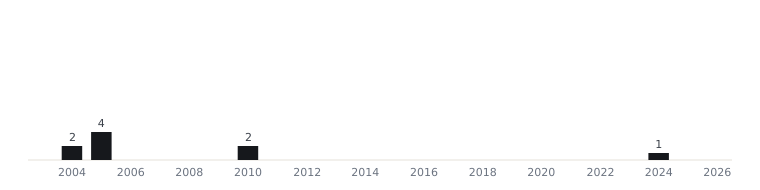
In all, OSHA issued 63 citation items: 37 serious and 26 other-than-serious.
The proposed penalties came to $24,595; today they stand at $16,415, 33% less.
The rule cited most here is 1926.550 ([reserved]), 8 times.
Among construction employers, the typical cited inspection since 2015 ends with a $3,079 penalty. Gray Construction Company averages $8,685 across 1 cited inspection.
Gray Construction Company also files yearly injury logs with OSHA, summarized below.
It reported 1 severe injury to OSHA since 2015.
Citation items per year, by inspection date.
Want to know if OSHA cites Gray Construction Company again? Add it to a watchlist and we will email you the morning the citation shows up.
Incident on Feb 25, 2002: Employee injured after being pinned in ceiling collapse
On February 25, 2002, Employee #1 was working with coworkers remodeling a mens' rest room at a baseball stadium. A skid steer loader was being used to remove a concrete wall. The ceiling collapsed after a portion of the wall had been remove d pinning Employee #1 to the floor. Employee #1 suffered a cervical neck injury but did not require hospitalization.
From the Form 300A summaries employers file with OSHA each year. Rate = recordable cases per 100 full-time workers.
In 2023, the Watertown site logged 3 recordable injuries or illnesses among about 37 workers: 10.1 per 100 full-time workers, against a median of 0.6 for its industry. Those cases cost 14 days away from work.
Site and year
Workers
Cases
Days-away cases
Rate
Industry median
Gray Construction Co
Watertown · 2023
37
3
1
10.1
0.6
Severe injury reports
Employers must report any work-related amputation, in-patient hospitalization or loss of an eye to OSHA within 24 hours. 1 report on file.
Oct 21, 2024, Watertown: Hospitalization · multiple traumatic injuries and disorders unspecified · multiple body parts n.e.c.
An employee fell 25 feet off a roof that was being sheathed. The employee suffered a fractured clavicle and femur, as well as head and hip injuries. Fall protection was not being worn at the time.
The rules behind these citations
Current text from the Code of Federal Regulations. Some citations were issued under older wording.
(5) Exposure of blades. When the periphery of the blades of a fan is less than seven (7) feet above the floor or working level, the blades shall be guarded. The guard shall have openings no larger than one-half ( 1/2) inch.
(c) Hand-fed ripsaws. (1) Each circular hand-fed ripsaw shall be guarded by a hood which shall completely enclose that portion of the saw above the table and that portion of the saw above the material being cut. The hood and mounting shall be arranged so that the hood will automatically adjust itself to the thickness of and remain in contact with the material being cut but it shall not offer any considerable resistance to insertion of material to saw or to passage of the material being sawed. The hood shall be made of adequate strength to resist blows and strains incidental to reasonable operation, adjusting, and handling, and shall be so designed as to protect the operator from flying splinters and broken saw teeth. It shall be made of material that is soft enough so that it will be unlikely to cause tooth breakage. The hood shall be so mounted as to insure that its operation will be po
29 CFR 1910.213(c)(2)
(2) Each hand-fed circular ripsaw shall be furnished with a spreader to prevent material from squeezing the saw or being thrown back on the operator. The spreader shall be made of hard tempered steel, or its equivalent, and shall be thinner than the saw kerf. It shall be of sufficient width to provide adequate stiffness or rigidity to resist any reasonable side thrust or blow tending to bend or throw it out of position. The spreader shall be attached so that it will remain in true alignment with the saw even when either the saw or table is tilted. The provision of a spreader in connection with grooving, dadoing, or rabbeting is not required. On the completion of such operations, the spreader shall be immediately replaced.
Source: U.S. Department of Labor, OSHA enforcement data. A citation is OSHA's allegation; employers can contest it, and the status column shows where each item stands. Something wrong on this page? Tell us.